
'If you look at household hospitalisation compensation, then you will find only one-third is hospitalisation. Two-thirds is outpatient.' 'Even if you provide Rs 5 lakh coverage, people will still have a tough time.'

Will Arundhati Bhattacharya be the RBI's first woman governor? Or will Urjit Patel succeed Raghuram Rajanas RBI governor when his term ends on September 4?
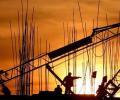
Whilst substantive public allocations have been made in the infrastructure sector, this strategy is plateauing due to the fiscal deficit constraint, capacity limitation of statal implementing agencies, the declining ability of PSUs, and the precarious situation of the Railways' operating ratio. It is, thus, high time to get the policy compass to point at rejuvenating private sector investments in infrastructure, says Vinayak Chatterjee.
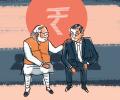
'India's economic fundamentals are much too strong to be affected by his resignation,' says B S Raghavan.
'Nirmalaji's Budget announcements have long-term implications and are not backed by enough money when the short-term outlook looks bleak,' notes T N C Rajagopalan.

While most brokers have upgraded their backend systems to trade, their front-end systems have not been upgraded. They are not compliant with Sebi's interop circular of November 2018 and no one seems to be either aware of this, nor has anything been done about it so far, explains Debashis Basu.

Banks in India must have a modern approach, suggests a panel comprising of banking bigwigs.

'We get to know secrets such as some of India's top-rated firms do not always make payments when due and many State-owned, listed, enterprises that borrow in bond markets default regularly.' 'Without naming the bank, he says that ever-greening of poor loans by a part of India's shadow banking lay at the doorstep of India's banking, notably 'one private bank'.' Viral Acharya's Quest for Restoring Financial Stability in India won't be music to many ears, observes Tamal Bandyopadhyay.
Growth in India will pick up from current levels, says LEO Puri, managing mirector, UTI Asset Management Company.


He said RSS men were planted in each ministry.

Chief Minister MK Stalin has shown that he is cut from a different cloth when it comes to embracing what is current, modern and absolutely necessary. Thus, even while retaining the spirit and content of the pan-Tamil, Dravidian socio-political and socio-economic ideology to the 't', his government has also acknowledged the need to accepting scientifically-proven facts in operational matters, says N Sathiya Moorthy.

Lower revenue collection puts upward pressure on government borrowing, ensuring that it deviates from the glided path of debt reduction

Rahul Khullar's guiding credo was that a civil servant must never lose sight of his client: The little guy. The evil men are those who are decision-makers but abdicate their responsibility of taking decisions, leading people to lose confidence in public institutions.

Many in the US establishment must hope that the crisis would put the brakes on China's growing military might. Well, it ain't gonna happen, says T T Ram Mohan, who was appointed a member of the prime minister's economic advisory council on Wednesday, October 28, 2021.

Most mainstream researchers agree that good governance is a necessary condition for growth.

Agricultural incomes can be taxed without hurting farmers, as a substantial section - the small and marginal ones - will remain outside the tax net simply because their incomes are likely to be below the basic exemption limit of Rs 250,000 per annum that is extended to all taxpayers in India, finds out Ishan Bakshi.
Last week, the government had introduced a fresh round of austerity measures, including bans on first class travel, creation of new posts and holding meetings in five-star facilities.

As India emerges from the COVID-19 crisis, the ninth budget under the Modi government, including an interim one, is widely expected to focus on boosting spending on job creation and rural development, generous allocations for development schemes, putting more money in the hands of the average taxpayer and easing rules to attract foreign investments.
Has the Modi government ensured that the MEA keeps abreast of the times, asks Ambassador Vivek Katju.
Reduce the government stake in public sector banks to 33 per cent, recommends A K Bhattacharya

Finance Minister Arun Jaitley said RBI and the government are in continuous dialogue and that relationship will continue.

Decision-making has to be much quicker, the finance minister said.

Mudra Bank will be a Rs 20,000-crore institution, which would "primarily be responsible for refinancing all micro-finance institutions.

In the new decade, the scene will change because the banks till recently had been challenged by the fintechs, but the techfins have now entered the arena, observes Tamal Bandyopadhyay.

'...Unless we muck up our policies.' 'We have to become a modernised economy.' 'Our institutions should be stronger. And that is most important.' 'The rule of law should prevail and contracts should be enforced.' 'Above all, we have to recognise the importance of globalisation.' 'It is in our favour at this stage. We should grow and become globally competitive.'

Admittedly, EVMs too have a UID number and any convergence of data can make the secret ballot system a party of history, warns Dr Gopal Krishna in the 5th part of his series against Aadhaar.

Bhargavi Zaveri & Radhika Pandey explains how complexities of foreign exchange rules are used by India Inc to dispute contractual obligations.
Multiple organisations of different kinds with overlapping goals would be a dream situation for those who believe in competition and innovation.

Inviting private sector in Indian Railways is a good idea.

Tamal Bandyopadhyay offers some unsolicited advice for a government wh,ich came to power, with brute majority and the nation's pragmatic chief money man.

The pipeline for well-qualified and experienced policy economists at senior levels of government has broken, leading to a growing dearth of suitable candidates for top economist positions.

The change in policy for the three companies, from listing to merger, shows the level of discomfort within the government about their ability to take on the expanded load for insurance coverage with their current financial strength, including the massive premium and claim settlement cover under the proposed universal health coverage plan announced in Budget 2018.

Officials said both the factions of the Hurriyat are likely to be banned under Section 3(1) of the Unlawful Activities (Prevention) Act, or the UAPA, under which "if the Central Government is of opinion that any association is, or has become, an unlawful association, it may, by notification in the Official Gazette, declare such association to be unlawful."

The Budget will indicate where the Modi government stands on reforms, growth and development.

'You cannot fight a disease as complex as COVID-19 without a carefully calibrated, localised response.'

A K Bhattacharya digs into the yet-to-be-public report on ways to curb black money and finds out that Modi's next moves could include action on dabba trading, hawala, and education.
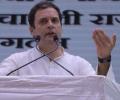
Rahul said that an atmosphere of fear has been prevailed in the country.
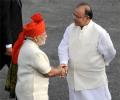
The Prime Minister said there is a need to have a relook at the structure of the Planning Commission and give it a new shape.

Hopefully, the grey world of central banking in a nation hit by demonetisation, will lighten up with some of his notes soon.
 © 2026 Rediff.com - Advertise with us - Disclaimer - Privacy Policy - Sitemap - Feedback - About us - Terms of use - Grievances